For an era when résumés and past-focused interviews alone no longer show real ability
From Credentials to Caliber
AI conversational simulation | Calaris Assess
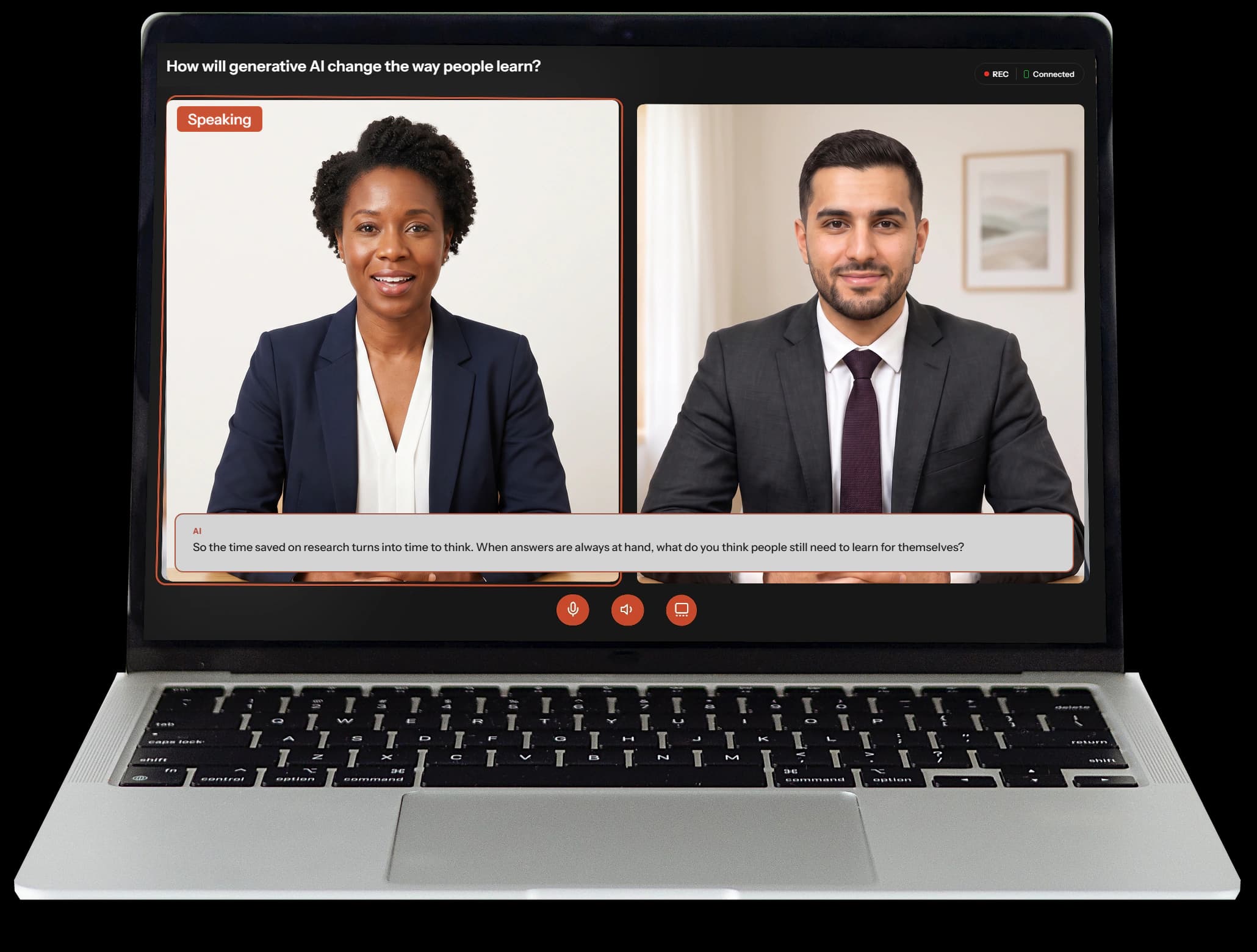
See how people think and act, not just what they've done
Generative AI polishes résumés and interview answers, so track records look alike. Our AI conversational simulations of work-like scenes show what's hard to prepare for: how candidates think and act in the moment.

Widen your pool and improve how you select
Sessions don't depend on interviewer availability, so you can avoid over-filtering on résumés and online aptitude tests and give more applicants dialogue as deep as a skilled assessor's.

Get an early read on job performance
Instead of past results, you see how candidates make decisions and engage others in job-like scenes, so you have what you need to gauge how they'd perform.

Stop missing strong candidates in early rounds
Find capable candidates that résumés and online aptitude tests bury. Everyone is compared on the same criteria, so fewer are missed through uneven ratings, and you can start winning over promising candidates early.
Recreate real work scenes with AI conversational simulation
Calaris Assess evaluates future potential from how candidates think and act in work-like dialogue with AI, and combines simulations to fit the role, target abilities, and your goals.

01
Problem Solving
How do they tackle problems with no set answer?
Mainly evaluates Cognition, using a business's growth strategy as the topic.
Example scenes
- Reviving a regional bus company
- Sizing an office snack service
Typical roles
- Consulting
- Corporate strategy & planning
- Business strategy & planning
- Investment & finance
- Graduate generalists
- Future executives

02
Client Engagement
How do they understand clients and move them to act?
Evaluates the ability to understand and influence people in client scenes.
Example scenes
- A client with lagging usage
- A client ask, a busy dev team
Typical roles
- B2B sales
- Consultative sales
- Advisory
- Customer success
- Graduate generalists

03
Customer Interaction
How do they engage with customers and respond?
Evaluates hospitality and responsiveness in customer-service scenes.
Example scenes
- A guest not eating at dinner
- Unsure about a phone plan
Typical roles
- Retail & services
- Hotels & airlines
- Store operations
- Customer support
- Customer-facing graduates

04
People Management
How do they understand people and help them grow?
Evaluates the ability to help others change how they act, in one-on-one and team development scenes.
Example scenes
- 1:1 after results dropped
- A new hire who never asks questions
Typical roles
- Managers
- Next-generation leaders
- Future executives
- Promotion to manager
- Graduate generalists
Note: For graduate generalists, we propose a mix of simulations based on the roles you prioritize.
Four technologies behind our advanced AI conversational simulation
Dialogue that draws out performance, sound criteria, hands-on support, and anti-cheating measures. Together, they aim to capture potential more reliably.
Transcript
- 02:14AIOpeningLet's start with your estimate. What annual revenue did you arrive at?
- 02:41About ¥300,000 a year per location: 50 users, 60% in the office, a 30% daily purchase rate, and ¥120 per item.
- 03:08AIWho's in the officeYour breakdown is clear. Why did you count only the people in the office?
- 03:35People who never pass the shelf can't buy, so I only counted those on site. I left out work-from-home days.
The more they answer, the deeper the questions go
01
Work-like scenes, recreated in dialogue with AI
Two-way dialogue that brings out what was hidden
Q&A interviews can struggle to dig beneath answers. Calaris generates the next question from each answer on the spot, probing the thought process and reasoning behind it. That depth underpins evaluation quality.
DETAILED BREAKDOWN
Cognition
Standard criteria shown. Dimensions and weights can be tailored to your company (varies by plan).
02
Future potential across four categories and 24 dimensions
Refined evaluation expertise behind every score
Grounded in academic research and talent assessment practice, our criteria span four categories to assess potential from multiple angles. Depending on your plan, you can calibrate items, standards, and weights per company against hiring outcomes and post-hire performance. The AI scores; your team makes every hiring decision (Human-in-the-Loop).

Support cycle
01Design
- Clarify hiring requirements
- Set evaluation criteria
- Design the scenarios
03
End-to-end, from hiring process design to operational improvement
Consulting from simulation design to operation
We support simulation design, criteria, and ongoing improvement to fit your hiring goals and roles. We also handle other formats, like episode-based dialogue that looks at the candidate as a person. Former consultants stay with you from design to post-launch improvement proposals.
Cheating detection
 AI
 Candidate
Log
- 12:04HighExternal display connection detected
- 7:58HighTried to copy text
04
Layered AI anti-cheating features
Cheating deterrence and detection, built for evaluation integrity
Cheating risk is rising in online hiring, wherever candidates take part. On-the-spot follow-ups already make it hard to rely on prepared answers or AI text read aloud, and layered detection and prevention features (which vary by plan) further support reliable, consistent evaluation.
Solutions by industry and challenge

01
Enterprise
Recreate client-proposal and problem-solving scenes to bring out real ability that AI has obscured
Learn more →
02
Consulting
firmsProblem-solving simulations bring top consultants' eye for talent to large applicant pools
Learn more →
03
Service & retail
Recreate customer-facing scenes and hire across stores to one standard
Learn more →
04
IT & technology
Assess engineers' technical and communication skills
Coming soon
05Startup & Scaleup
Startups & scaleups
Systematize the founder's eye for talent from your first hire
Learn more →
A skilled interviewer's craft, recreated by a team of AI agents
Skilled interviewers keep things natural so candidates show their ability, while reading their thinking, planning the next question, and evaluating at once. Calaris Assess splits this work among role-based teams of AI agents.

A skilled interviewer's craft
- 01
Conversing
Picks words with care, asks, nods, and listens so candidates show their ability without getting defensive. The professional skill of putting people at ease.
- 02
Analyzing what's said
Reads the assumptions and reasoning behind the words, spots where to dig for a candidate's real ability, and frames the question.
- 03
Evaluating from multiple angles
Weighs the evidence across several dimensions rather than a single impression, avoids bias, and asks neutral questions to cover dimensions not yet confirmed.
- 04
Organizing information
Tracks the key points and flow of the conversation, holding onto context when the talk jumps around and staying consistent throughout.

01Dialogue
Talks with
the candidate

02Analysis
Analyzes answers,
plans next question

03Evaluation
Finds and fills
evaluation gaps

04Synthesis
Organizes and
stores context

AI agentsA team of AIs for each role

Make the capabilities your change needs measurable
We define the capabilities your direction requires as a talent profile, then build them into simulation scenarios and scoring criteria. After launch, we support analysis and refinement.
Coming soon
For employee development, placement, and promotion
Assess employees with the same simulation. Scenes close to their expected roles show each person's potential, giving you data to find and develop next-generation leaders and decide on placement and promotion.
Coming soonSecurity and AI governance for peace of mind
Certifications and third-party testing
- ISO 27001 (ISMS)
- Vulnerability assessment and penetration testing
- Cyber insurance
AI governance
- Human-in-the-Loop, applied throughout
- Measures against evaluation bias
Data architecture
- Data encryption
Calaris's AI conversational simulation vs. common interview methods
Our view of how AI conversational simulation compares with in-person, online, and typical AI interviews.
Interview style and depth vary by company and interviewer; AI interviews vary by product.
Dialogue quality
- AI conversational simulation
- Follows up on each answer to draw out thinking
- In-person interview
- Digs deep on the spot; varies by interviewer
- Online interview
- Digs deep, even over video; varies by interviewer
- AI interview
- Mostly set questions; follow-up depth varies by product
Evaluation quality
- AI conversational simulation
- Deeper dialogue makes candidate differences clearer
- In-person interview
- Draws on interviewer experience; aligning criteria is key
- Online interview
- Draws on interviewer experience; aligning criteria is key
- AI interview
- Easy to use the same dimensions; differences in thinking may be harder to see
Evaluation bias
- AI conversational simulation
- Same criteria for every candidate, reducing variation
- In-person interview
- Training and panels can reduce variation
- Online interview
- Training and panels can reduce variation
- AI interview
- Fixed scoring keeps variation low
Scalability
- AI conversational simulation
- Not tied to interviewer availability; handles high volumes
- In-person interview
- Needs interviewers and a venue
- Online interview
- Needs interviewers' time
- AI interview
- Not tied to time slots; handles high volumes
Countering AI misuse
- AI conversational simulation
- Layered anti-cheating measures
(vary by plan) - In-person interview
- Face to face, so AI use is unlikely
- Online interview
- AI use off screen is hard to check
- AI interview
- Set questions are open to advance preparation and AI use
- Strong
- Varies by interviewer
- Limited
- Difficult